Payroll, done right. IDup calculates salaries, deductions, contributions and payslips automatically — accurate, on time, every month, without a spreadsheet and without a week of nerves before pay day.
Payroll is the one process in a business where being roughly right is the same as being wrong. Employees notice a mistake in their net pay immediately, authorities notice a wrong contribution eventually, and both cost you far more than the time saved. Yet in most small companies payroll still runs on a mix of manual calculations, remembered rules and a monthly email to an external office — a process that breaks the moment someone is ill, joins mid-month or changes their workload.
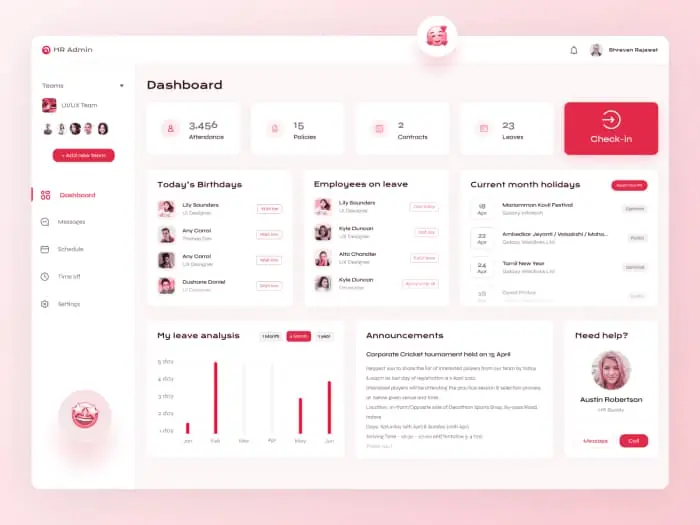
IDup turns it into a routine that runs itself. Contracts, rates, working time, absences and one-off payments already live in the employee record, so the run assembles itself from data that is already correct. You review, confirm and release — payslips are generated and available to your team in the portal, and the whole run posts straight into your accounting with the right accounts and the right period.
Salaries, deductions, contributions and allowances calculated for you from contracts, hours and absences that are already in the system. Mid-month joiners, leavers and workload changes are handled, not improvised.
Generate and share payslips instantly — branded, clear and available to each employee in their own self-service portal. No printing, no envelopes, no re-sending a payslip somebody lost in March.
Correct rates and contributions per country, with the reports and exports your authorities and insurers expect. Rules are maintained in the platform, so keeping current is not a task on anyone’s calendar.
Every payroll run is booked automatically into the right accounts and the right period, so personnel cost appears in your P&L and cash view immediately instead of after a manual journal entry.
Automatic calculation means fewer mistakes and far less manual work every month. The figures come from the same records your contracts, time tracking and absence management already maintain, so there is no transcription step where errors are born.
Anything unusual is flagged before the run is released: a missing bank detail, an absence that overlaps a contract change, an hourly employee with no recorded hours, a one-off payment that looks out of pattern. You correct a short list of exceptions instead of checking everything.
And every run keeps its full history. What was paid, on what basis, calculated with which rates, approved by whom and when — retrievable years later, which is precisely what makes a payroll audit uneventful.
Run payroll in minutes and deliver payslips instantly. What used to be a day blocked out at the end of the month becomes a review you can complete between two meetings — and the deadline stops moving your other work around.
Recurring elements run on their own: fixed salaries, standing allowances, deductions and recurring bonuses are applied automatically each period, and only genuine changes need your attention.
Because the run is reproducible rather than hand-built, it does not depend on one person. If the colleague who normally handles payroll is ill in the last week of the month, someone else can complete it correctly — the process is in the system, not in their head.
Every payroll run posts straight into your accounting — gross salaries, employer contributions, deductions and net payments, on the correct accounts, in the correct period, with the run documented behind each figure.
That closes the largest gap most small businesses have in their numbers. Personnel cost is usually the biggest line in the P&L and the one that arrives last; here it is booked the moment the run is released.
With time tracking connected, salary cost also lands where it was actually generated: per project, per client, per department. You stop estimating whether a project was profitable and start reading it.
The invoice from your payroll provider is the visible cost. The invisible one is larger: the hours spent collecting hours and absences, the emails back and forth about a change that arrived too late, the corrections in the following month, and the time nobody bills because the data sat in three places.
Add the risk. An incorrect contribution or a missed deadline is not a rounding error — it is a back-payment plus interest, and it usually surfaces long after the person who made the mistake has moved on.
IDup removes both by making the payroll run a read of data you already maintain rather than a monthly reconstruction of it. Contracts, hours, absences and one-off payments are already correct, so the calculation is a consequence rather than a project — and the cost of payroll drops to the time it takes to review it.
Payroll is one part of IDup, not the whole product — and you don’t pay extra for the rest. The same login gives you accounting with AI receipt capture, invoicing and online payments, tax filing and annual statements, financial reports, employee management, a complete CRM with leads, estimates, contracts and projects, a helpdesk, a client portal, permissions and multi-tenant workspaces.
It also gives you the modern layer most payroll tools simply don’t have: IDup AI as an assistant across the whole platform, an AI chatbot for your website, automated workflows that run recurring work for you, a social media agent, marketing campaigns, and a shared inbox for WhatsApp, SMS, email and social conversations.
The practical effect is that the largest cost in your business finally sits in the same system as the revenue it produces — live, per project and per period, on desktop and in the mobile app, GDPR-compliant, on secure servers worldwide, in 27 languages, with no prior knowledge required.

Anita R.
This system has completely transformed the way we manage payroll. What used to take days is now done in just a few hours. It’s accurate, compliant, and incredibly user-friendly!

Mohammed S.
The integration with our biometric attendance system was seamless. Now, everything from attendance to salary slips runs automatically. It’s a game-changer for our HR operations.

Lena D.
Our employees love the self-service portal. They can check their payslips, apply for leave, and update their details without constantly reaching out to HR. It’s saved us so much time.

Rajeev T.
We’ve been able to cut down payroll errors by almost 90% since switching to this system. The reports are detailed and help with our compliance and audits. Highly recommended.
IDup unifies accounting, invoicing and payments, AI receipt capture, tax filing, annual statements and financial reports with a full CRM — leads, estimates and contracts, projects, tickets, calendar and a client portal. On top of that sit IDup AI, an AI chatbot, automation and a social media agent, a shared inbox for WhatsApp, SMS, email and social, marketing campaigns, employee and payroll management, permissions, multi-tenant workspaces, a document vault, cloud access and a mobile app for iOS and Android.
All of it runs behind one login, on one database, for one price — so an employee, their hours, their salary, the project they worked on and the booking in your accounts are the same data instead of five separate systems.
IDup handles country-specific rates, contributions and reporting requirements, and supports 20 currencies and 27 languages — which matters as soon as you employ people in more than one country or pay someone in a currency other than your own.
Because rules are maintained centrally in the platform, rate changes do not become a project on your side. Your run simply uses the values that apply to the period you are paying.
They are handled properly rather than approximated. A mid-month start, a departure, a change of workload or an unpaid absence is calculated pro rata from the contract data in the employee record.
Because the contract history is versioned, the run always uses the terms that were valid in that period — not the terms that happen to be current when you press the button. That is what keeps retroactive corrections rare and defensible when they do occur.
Yes. Each employee has a self-service portal where they can download current and historical payslips, update their address and bank details and see their absence balances.
That removes a steady stream of small requests from your week and, more importantly, keeps the master data accurate — people correct their own details far more reliably than a central process ever does.
Yes. IDup is GDPR-compliant, hosted on secure, GDPR-compliant servers worldwide, with encryption in transit and at rest. Salary data is protected by granular permissions, so only the roles you designate can see it, and every access is logged.
Payslips and payroll documents are stored in an audit-proof archive with retention rules applied, instead of being emailed as PDF attachments to private mailboxes.
No. IDup is built so you can start right away — no payroll background needed. The run is guided, exceptions are explained in plain language and nothing is released until you confirm it.
You can also keep your accountant or payroll office in the loop with their own login and permissions, so a professional reviews the run without you having to export or email anything.
Yes — through an open REST API, webhooks and ready-made integrations, plus standard exports for authorities, insurers and banks. Payment files can be produced for your bank so net salaries are transferred without manual typing.
Where accounting, time tracking and HR would normally need connectors, they are already the same platform, which removes the most error-prone integrations entirely.
Minutes to set up, one period to switch over. Add your employees, enter their contract terms and run a trial calculation before you release anything.
Most companies start with the next full month, keep the previous year as documents, and are done with the transition after a single reviewed run.
Copyright © 2025 - IDup. All rights Reserved.